

How the Vortice Disc™ Helps Reduce Back Pain Naturally

Updated: Mar 16

Understanding Back Pain and How the Vortice Disc Supports the Body
Back pain rarely remains confined to one small area.
For some individuals, discomfort begins in the lumbar (lower) spine and gradually radiates upward. For others, it emerges between the shoulder blades (thoracic spine), spreads across the mid-back, or extends into the cervical (neck) region.
This variation occurs because the spine functions as a connected biomechanical chain — when one segment is strained or misaligned, surrounding muscles and joints often compensate, leading to pain in multiple areas.
The human spine is made up of 33 vertebrae separated by intervertebral discs, which act as shock absorbers. These discs consist of a tough outer layer (annulus fibrosus) and a gel-like center (nucleus pulposus) that distributes pressure during movement.
Over time, factors such as prolonged sitting, poor posture, repetitive strain, muscle imbalances, and age-related disc dehydration can increase mechanical stress on these structures. Research shows that reduced spinal mobility, weakened core musculature, and altered load distribution are strongly associated with chronic back pain.
Pain itself can present in different forms.
Sharp or acute pain often signals tissue irritation or inflammation.
Dull, aching pain may be related to muscular fatigue or postural strain.
Tightness or stiffness frequently reflects protective muscle guarding around sensitive joints.
Radiating pain can occur when spinal nerves are compressed or irritated.
Because back pain often involves both muscular and structural components, many people are exploring supportive, non-invasive approaches alongside traditional care.

Why Back Pain Can Occur Anywhere Along the Spine
Clinical guidelines for managing non-specific back pain increasingly recommend conservative strategies first — including movement therapy, postural correction, heat application, and supportive devices that encourage proper spinal alignment.
Support tools such as the Vortice Disc™ are designed to complement the body’s natural biomechanics. By providing targeted support to specific regions of the back, such tools may help:
Encourage more neutral spinal alignment
Reduce uneven pressure across vertebrae and discs
Promote muscle relaxation by decreasing compensatory tension
Support improved posture during sitting or standing
When the spine is better supported, surrounding muscles do not have to work as aggressively to stabilize the body. This can reduce fatigue and allow tissues to recover more efficiently.
Understanding the underlying mechanisms of back pain — including disc mechanics, muscle coordination, and nerve sensitivity — helps clarify why gentle, consistent support can be beneficial.
While no single device replaces proper movement, strengthening, or medical evaluation when needed, supportive tools like the Vortice Disc™ may play a role in a broader, natural approach to spinal comfort and functional well-being.

A Natural Approach to Reducing Back Pain: The Science
Many individuals seeking natural approaches to back pain management prefer strategies that support the body’s intrinsic regulatory mechanisms rather than relying solely on pharmacologic symptom suppression. Contemporary pain science recognizes that back pain is influenced by complex interactions among musculoskeletal tissues, inflammatory mediators, and the central nervous system (Hartvigsen et al., 2018; Foster et al., 2018).
Noninvasive, non-pharmacological interventions are commonly recommended as first-line strategies for many forms of low back pain. Clinical guidelines emphasize approaches that do not rely on medication, heat, or electrical stimulation alone, but instead aim to modulate pain perception and inflammatory processes through biomechanical, neurological, or cognitive pathways (Qaseem et al., 2017; WHO, 2023).
Pain perception is not solely a direct reflection of tissue damage. Rather, it arises from dynamic signaling between peripheral nociceptors, spinal processing pathways, and higher brain centers (Tracey & Mantyh, 2007; Woolf, 2011). Inflammation similarly involves tightly regulated immune signaling processes that can either promote healing or contribute to persistent discomfort depending on context (Medzhitov, 2008).
Noninvasive physical devices designed to avoid spinal immobilization or joint compression aim to minimize biomechanical disruption while potentially supporting comfort. However, for any such device to influence inflammation or pain perception directly, mechanisms of action would need to be biologically plausible and empirically demonstrated in controlled human studies. Currently, established evidence supports interventions such as movement therapy, graded activity, spinal manipulation, cognitive behavioral approaches, and exercise-based rehabilitation in modulating pain processing and inflammatory markers (Foster et al., 2018; Hayden et al., 2021).
Importantly, supporting the body’s ability to “settle and regulate” aligns with modern understanding of pain self-regulation. Recovery from many cases of back pain is associated with normalization of nervous system sensitization, improved tissue conditioning, and adaptive immune responses (Woolf, 2011; Hartvigsen et al., 2018). Interventions that are gentle, noninvasive, and that promote safety and movement may help facilitate these regulatory processes when supported by clinical evidence.
References
Foster, N. E., Anema, J. R., Cherkin, D., et al. (2018). Prevention and treatment of low back pain: Evidence, challenges, and promising directions. The Lancet, 391(10137), 2368–2383. https://doi.org/10.1016/S0140-6736(18)30489-6
Hartvigsen, J., Hancock, M. J., Kongsted, A., et al. (2018). What low back pain is and why we need to pay attention. The Lancet, 391(10137), 2356–2367.
Hayden, J. A., Ellis, J., Ogilvie, R., et al. (2021). Exercise therapy for chronic low back pain. Cochrane Database of Systematic Reviews, Issue 9.
Medzhitov, R. (2008). Origin and physiological roles of inflammation. Nature, 454, 428–435.
Qaseem, A., Wilt, T. J., McLean, R. M., & Forciea, M. A. (2017). Noninvasive treatments for acute, subacute, and chronic low back pain: Clinical practice guideline. Annals of Internal Medicine, 166(7), 514–530.
Tracey, I., & Mantyh, P. W. (2007). The cerebral signature for pain perception and its modulation. Neuron, 55(3), 377–391.
WHO. (2023). WHO guidelines on the management of chronic low back pain. World Health Organization.
Woolf, C. J. (2011). Central sensitization: Implications for the diagnosis and treatment of pain. Pain, 152(3 Suppl), S2–S15.
Using the Vortice Disc™ for Upper & Lower Back Support
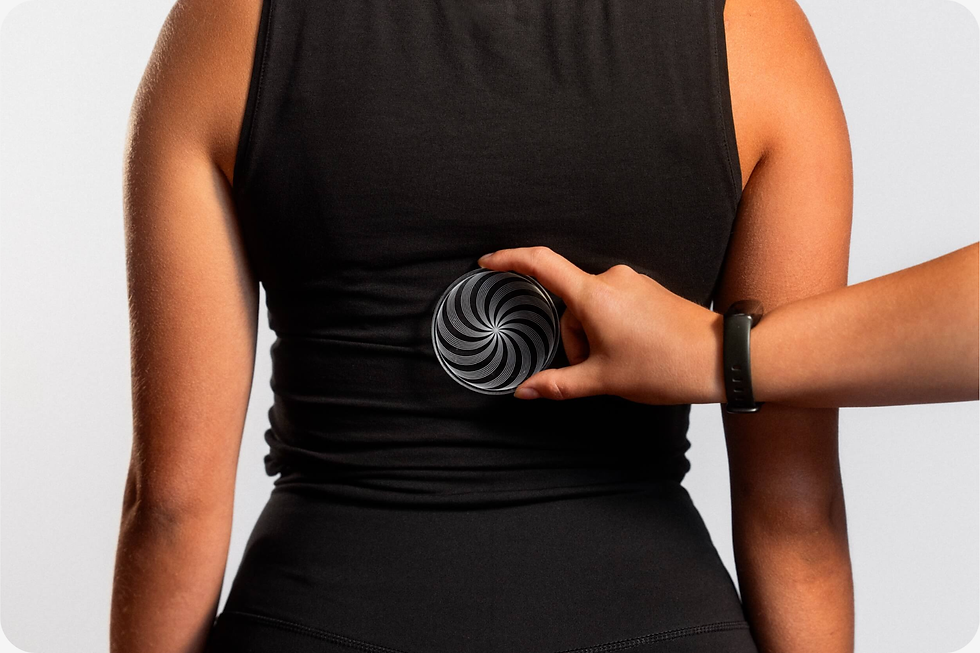
When using the Vortice Disc™ to help relieve back discomfort, placement should be tailored to the area where tension or irritation is most noticeable.
Recommended placement areas:
Over the sacroiliac (SI) joint on the side of the lumbar spine where discomfort is greatest.
Two to three inches to either side of the midline of the lumbar or thoracic spine, focusing on the side with the most discomfort.
Approximately one inch to either side of the midline of the cervical spine, on the side where discomfort is most pronounced.
Secure the Vortice Disc™ in place using FixiC self-adhesive patches or a similar hypoallergenic adhesive.
Because back discomfort often involves more than one region, some individuals choose to use multiple discs, placing them in the areas that feel most sensitive or reactive.
This is a gentle approach. The Vortice Disc™ is not designed to brace the body or force alignment; rather, it is placed where the body appears to be signaling stress.

Patient Response to the Vortice Disc™: What Users Commonly Report
Individual experiences may vary, but many users who apply the Vortice Disc™ for full back discomfort commonly report:
A gradual release of muscular tension
Decreased intensity of ongoing aches
Less stiffness after sitting for long periods or upon waking
Improved comfort when standing, bending, or reaching
Many describe the effects as subtle and progressive rather than immediate. Over time, the back may feel calmer and less reactive, supporting more natural, comfortable movement.
For those seeking a natural approach to back pain relief, even small improvements in daily comfort can enhance mobility and encourage greater consistency with stretching and strengthening routines.

Why a Gentle Strategy Matters
Back pain is often multifactorial. Aggressive interventions are not always necessary, particularly when discomfort is related to posture, tension, or overuse.
A gentle, supportive approach matters because it:
Allows continued movement
Does not interfere with other therapies
Does not introduce systemic substances
Can be integrated into daily life
The Vortice Disc™ has no known systemic side effects. The only commonly reported issue is mild skin irritation due to adhesive sensitivity, which resolves after removal.
For individuals seeking to reduce back pain naturally, this safety profile supports its use as part of a broader plan.
Supporting the Whole Back, Not Just One Area
Because the spine functions as an interconnected system, relieving full back discomfort often benefits from a comprehensive approach that may include:
Mobility and flexibility exercises
Strengthening and stabilization work
Postural awareness and ergonomic support
Stress management techniques
Supportive tools when appropriate
Many individuals also find added benefit when incorporating physical therapy and massage therapy into their routine. Physical therapy can help improve movement patterns, restore strength, and enhance spinal stability, while massage therapy may assist with muscle relaxation, circulation, and overall comfort.
The Vortice Disc™ is not presented as a cure or a substitute for professional medical treatment. Instead, it is commonly used as a complementary tool within a broader, natural back support strategy. Always consult a qualified healthcare professional before beginning any new treatment or wellness practice.
When paired with consistent movement, recovery habits, and therapeutic care, the Vortice Disc™ may offer a supportive option for those seeking to reduce back discomfort naturally while promoting the body’s inherent adaptability and resilience.
Safety and Side Effects
An important aspect of evaluating any health-related technology is safety.
To date, there have been no documented systemic side effects associated with the Vortice Disc™ itself. The technology is noninvasive, does not introduce chemicals, electricity, heat, or magnetic force into the body.
Dr Flick notes with his clinical patients:
"The only reported adverse effect has been mild skin irritation. This skin irritation appears to be a reaction of the adhesive tape. Removing the tape has resolved the skin irritation. A mild itching sensation beneath the disc has been experienced by a few individuals."
This safety profile is one of the reasons the Vortice Disc™ is positioned as a low-risk, noninvasive option for individuals seeking drug-free support for pain and inflammation, while still emphasizing responsible use and realistic expectations. Removing the disc and rinsing with water has relieved any itching sensation when the disc is replaced over the area of treatment.

This content is for general educational purposes only and is not intended as medical advice. Always consult a healthcare professional regarding any pain, injury, or medical condition.
The Vortice Disc™ is not intended to diagnose, treat, cure, or prevent any medical condition. Individual results may vary. The Vortice Disc™ is a wellness product and has not been evaluated by the U.S. Food and Drug Administration (FDA).


Comments